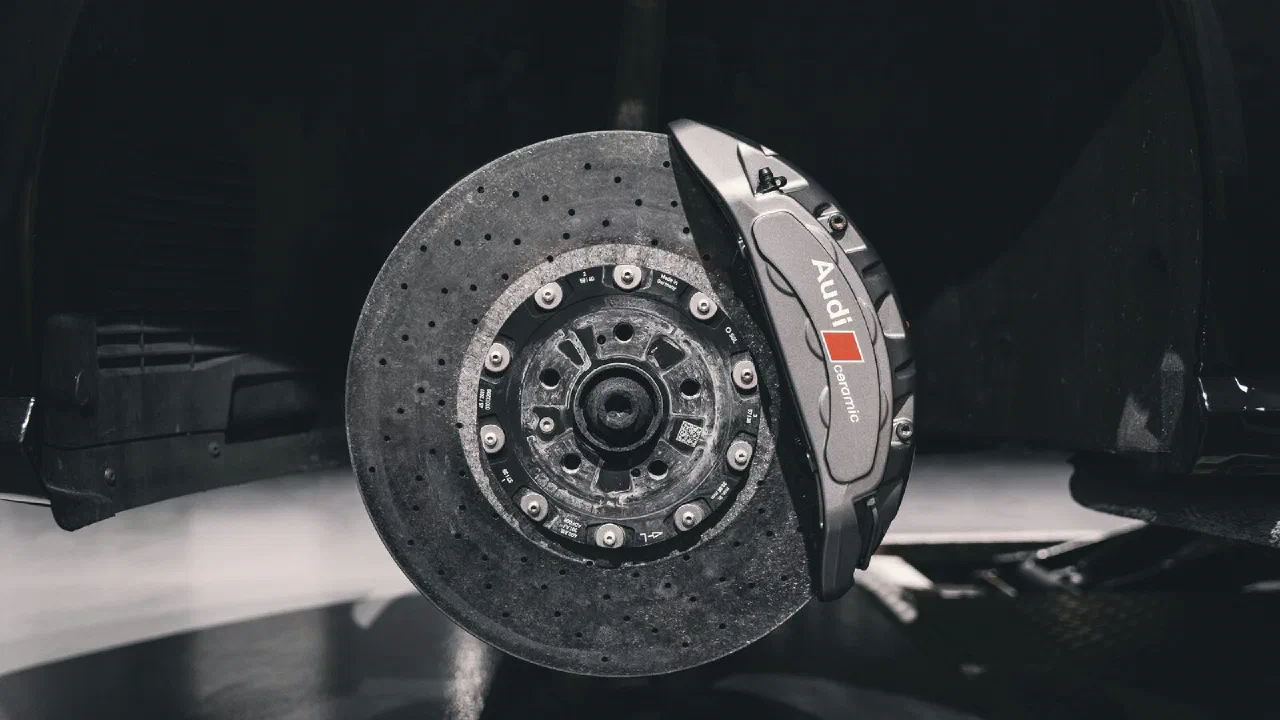
Before you authorise a caliper, get the part’s brand, part number and price on the quote as its own line. On a caliper job the part is most of the money, and the two largest published figures for it differ by roughly six times — so the parts line is where a caliper quote is won or lost, not the labour.
The second thing worth knowing is that the caliper is often not what failed.
The two published prices, and the gap between them
Both checked 4 September 2026:
| Source | What it publishes | Figure |
|---|---|---|
| RepairPal | Caliper replacement, total | $898–$968 |
| RepairPal | Parts portion | ~$749 |
| RepairPal | Labour portion | $150–$219 |
| Jiffy Lube | A single caliper | Up to $130, “some higher” |
RepairPal’s labour and Jiffy Lube’s caliper price are not in conflict — they are pricing different things, and $150–$219 of labour is a believable number for the work. The conflict is the parts line. One of the largest cost estimators in this vertical publishes about $749 of parts for a job that the largest service chain says involves a component costing up to $130.
The reconciliation is probably some combination of calipers quoted in pairs, new rather than remanufactured units, and vehicles where the caliper carries an electric parking brake motor — which are genuinely expensive. But no published page says which, and that is exactly the problem. A quote that names the part answers the question. A quote that gives you a total does not.
Ask three things: is this one caliper or two, is it new or remanufactured, and what is the part number and its price.
What usually fails before the caliper does
A caliper is a piston in a bore with a seal, mounted on a bracket by two guide pins that let it float. Two of those parts seize far more readily than the caliper body ever wears out:
- The guide pins. They live behind rubber boots packed with grease. When a boot splits, the grease washes out, the pin corrodes and the caliper stops sliding freely. The symptom is uneven pad wear — inner pad gone, outer pad barely touched, or the reverse.
- The piston seal and boot. A torn boot lets water in behind the piston. The piston stops retracting cleanly, the pad drags, and that corner runs hot.
Both of those have repairs that are not “replace the caliper”. Guide pins and boots are sold as hardware kits; a seized piston can sometimes be addressed with a rebuild kit. Whether either is worth doing depends on the condition of the bore and on what the shop charges for the labour, and a shop is entitled to decline a rebuild it does not want to warrant.
But it changes the question you ask. Not “how much is a caliper”, but: what specifically is wrong with it, and is the bore or the slide the problem?
The symptoms that actually point at a caliper
Worth separating from the ones that get blamed on it:
- Pulling to one side under braking, consistently, on a dry flat road.
- One wheel noticeably hotter than the other on the same axle after a drive.
- Uneven pad wear across a single caliper — the classic seized-slide signature.
- A pad that has worn out far faster than its opposite number.
Not a caliper, usually: a pulsing pedal (that is thickness variation, and belongs with the rotor question); a soft pedal that improves after pumping (air or fluid, which is the fluid service); squealing on light braking (frequently pad material or hardware); a hard pedal with a hiss (which points at the booster).
Whether to do them in pairs
Shops commonly quote calipers in pairs on an axle, and the reasoning is real — matched braking force side to side. It is also the difference between a $130 part and a $260 one, so it deserves to be a decision rather than an assumption.
The case for both: one seized caliper often means the other has lived the same life in the same weather. The case for one: a caliper that measures and moves correctly does not need replacing because its neighbour failed. If the shop recommends the pair, ask what it found on the second one. There should be an answer — a torn boot, a stiff slide, a hot rotor — and if there is not, you are being quoted for symmetry.
Reading the quote
A caliper line should tell you the side, the part, whether it is new or remanufactured, and its price. The labour should be a number of hours at the shop’s rate. If the bracket hardware or a hose is included, those are separate parts and should be separate lines.
Once you have that, the arithmetic is easy and yours to do — and if the total is near $900 while the part on it is a $130 caliper, the question is not whether you need brakes. It is what the other $770 is. What a brake job actually costs is the wider version of that question.